

This guest blog was written by Laura Baringer of Purpose Built by Laura.
I see business owners constantly wrestle with a particular kind of uncertainty. I’m not talking about AI, Gen Z employees who’d rather text than call, or panic-inducing economic and political instability. I’m talking about something deeper: “If this business fails, who am I? What would that say about me and my value?"
When sales are down or a launch flops, these business owners don’t just take it as a data point. They see it as proof that they are not good enough. And then, when they need to pivot their business model or close down a loved initiative, it can feel like they are losing a part of themselves. When clients or customers stop buying, it feels like a personal rejection. This isn’t about resilience or confidence, it’s about identity.
I believe that all purpose-driven business owners have a bit of “I am my business.” It’s the very thing that makes them care so deeply. It’s the business mission, values, and commitment to making an impact.
But, it can also become the thing that traps them. When you are your business and uncertainty hits, it can be incredibly difficult to separate a threat to the business from a threat to oneself. You can’t zoom out and see the bigger picture because it all feels so personal.
I know how hard it can be to separate your identity from your work, because I lived it a few years ago in the career that came before my business today. I didn’t consciously choose that level of attachment, or think it was a problem. I only noticed it once it started to unravel.
When Your Identity Unravels
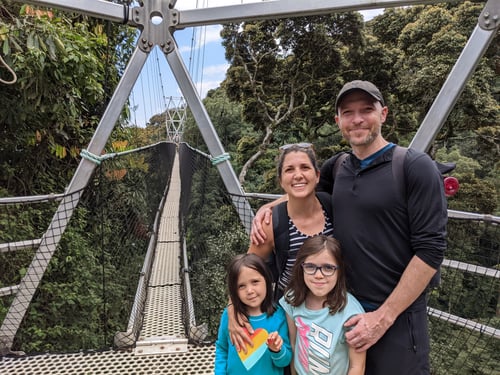
A few years ago, I moved my family to Kigali, Rwanda for my dream job. The job I'd been building toward for 15 years. I was building an office from scratch in adolescent health and digital products. It was my area of expertise, my passion, and my purpose. I was proud to tell people what I did. I felt worthy because I was in this field, doing this work.
The first year I was energized and fulfilled. Building something from nothing was scrappy and perfect for me.
But then things started slowly unraveling. My values clashed fundamentally with those of the head office. After months of trying harder, fixing more, and feeling increasingly lost and misunderstood, a series of small events made it brutally clear: nothing was going to change. The job couldn't be fixed. I needed to go.
But it was more than that. My values had clashed to such a degree that I knew I needed to leave the international development field entirely. That's when the bigger, scarier realization hit: I had no identity outside of being in the NGO field or public health. How could I be a good person if I didn’t work in this field?
This job was supposed to be the launch of a career trajectory that finally made sense. I was finally not going to question what was next anymore. I assumed my career growth would just come organically. My identity felt fixed and unmovable as an NGO leader, and I was desperately holding on.
Leaving this job meant I had to rethink how I defined myself as a person. I had to grieve what could have been and develop an identity that was expansive, changeable, and forgiving. An identity that was more than my work. This was something I had never had before.
But now, that separation is exactly what makes me a better business owner.
The Cost of "I Am My Business"
As a business owner now, it’s clear how an identity tied completely to your business makes uncertain times exponentially more uncertain. It’s like a boat in a storm. You want some slack in the line, otherwise the boat can’t move with the waves and it’ll take on too much water and sink.

When we hold tight to the belief that "I am my business," we risk:
Making decisions that reaffirm our identity rather than serve the business. We choose projects that sound big or impressive, feeding into a need to prove we're serious, rather than ones that actually serve our goals.
Being hesitant or unable to pivot when markets shift. When your identity is locked as "the founder who does X," changing your business model or adapting to technological or political changes feels like losing a part of yourself.
Mistaking threats to the business as threats to ourselves. A failed launch becomes proof we're not enough. A client saying no becomes a personal rejection. We can't separate business feedback from our worth as a person. This is when we make fear-based decisions, rather than ones from a place of calm and strategic thinking.
Building businesses that can't outlive us. If the business is you, succession planning feels like planning your obsolescence. You can't develop other leaders because that would mean you're replaceable. You tell yourself you're indispensable when really, you're trapped. They call it Founders Syndrome for a reason.
Expecting the same from our teams. We can't understand why employees want boundaries when we don't have any. We interpret their self-preservation as lack of commitment. We build cultures of burnout while calling it dedication to the mission.
Separating your identity from your business makes you a better business owner. I learned that my identity has layers, and yours does too. You might be thinking “of course it does”, but can you name them? And do you really believe it?
Years ago I would have told you, of course I’m a mother and a friend and an aunt - I’m not just my work. But I didn’t really believe it. My work had a hold over how I thought I was seen in the world.
If any of this sounds familiar, here are some questions you can sit with:
- What feels like your personal purpose, separate from a role, title or business? Borrowing from the Japanese concept of Ikigai: Where do what you love, what you’re good at, what the world needs and what you can be paid for overlap? Where might your work be one expression of that?
- When you imagine your life ten years from now, what do you hope is true beyond your business? If you knew you wouldn’t fail, what would you allow yourself to want in your work, your relationships, your pace, your sense of meaning?
And, before making a difficult business decision, you can ask yourself:
- Which identity feels threatened right now? What fear or attachment might be quietly influencing this choice?
- What would I do if I’m trusted enough regardless of this outcome?
This separation doesn’t mean caring less. It means seeing more clearly. When your identity isn’t fused to your business, you can make decisions based on what actually serves the business, your team, and the people you’re here to help.
That clarity is what allows you to build something more sustainable, more resilient in uncertain times, and more aligned with your real values. You stop performing the role of “founder” and start leading in a way your business actually needs.
When your worth isn’t riding on every outcome, you’re free to do the work the business is asking for, and you stop questioning who you are if it changes.

Submit Your Comment