
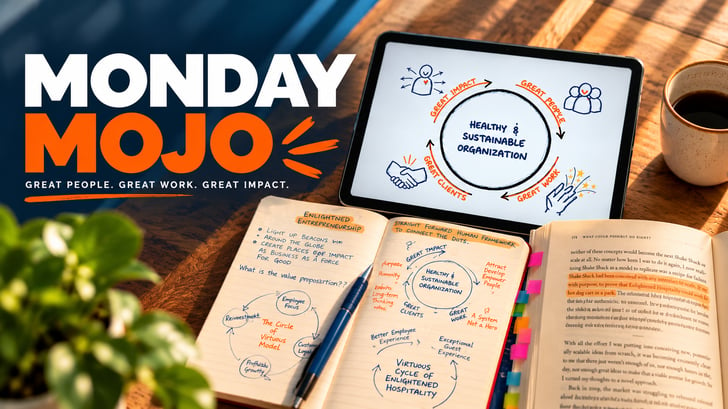
Three books, three circles, one idea.
I've been carrying three circles around in my head this month. One comes from Paul Spiegelman, who built BerylHealth and co-founded this community. One comes from Camille Nicita Higley, who's a mentor on our Sounding Board and wrote Open When. And one comes from Danny Meyer, whose new book I read on the flight home from our latest round of company visits.
They were written years apart, by people in different industries, who as far as I know never compared notes. And they are the same wheel.
Paul's Circle of Growth
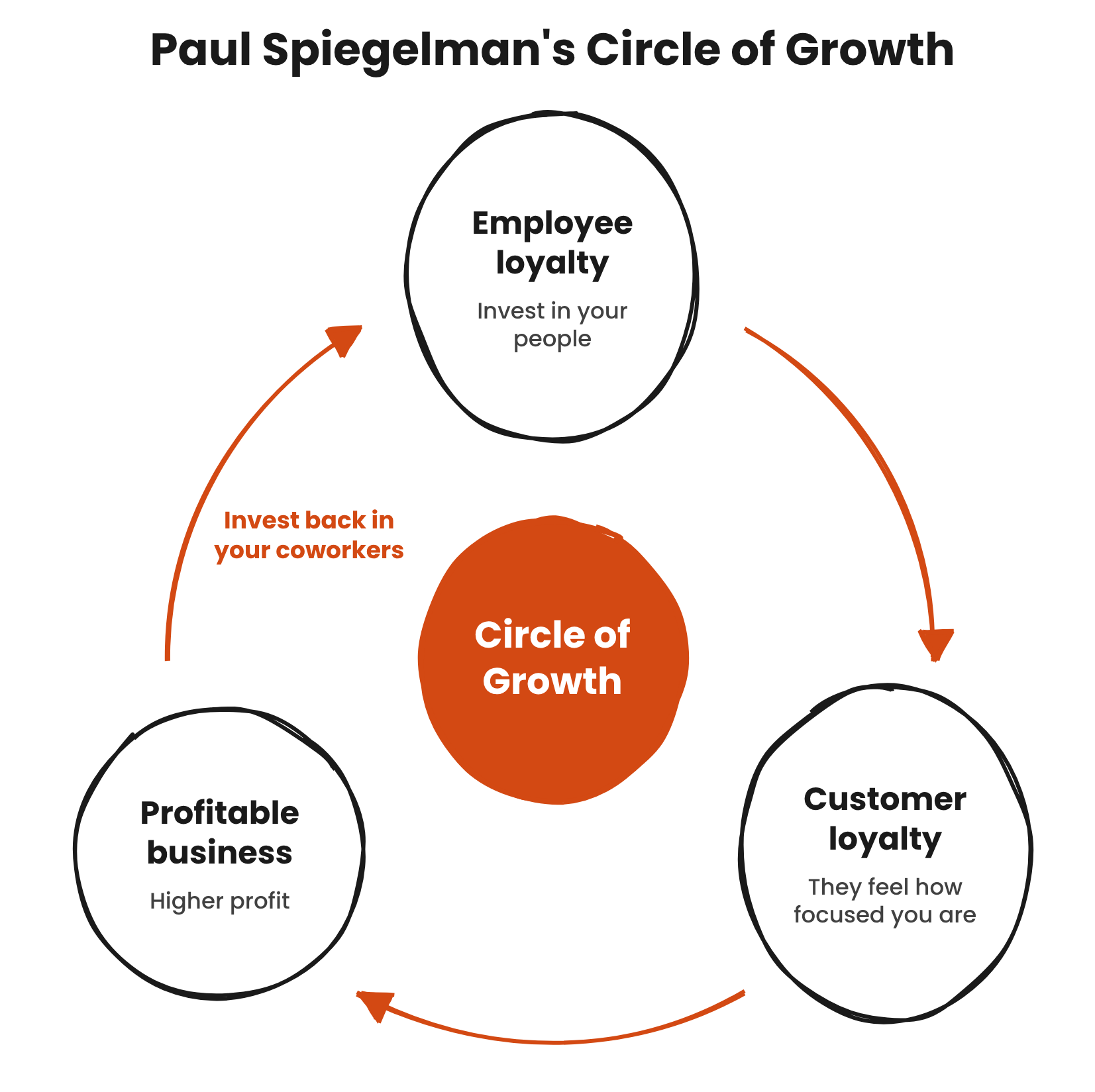
Paul built BerylHealth, a call centre business in Texas, which isn't an industry known for loving its people. For years he'd been investing heavily in his people on instinct. Then one day, driving to a meeting in Indiana, a sceptical and very analytical colleague turned the radio down and said: your strategy is like a circle...
Invest in your people and they become loyal and committed. Customers pick up on how focused your people are, and that drives client loyalty. That means higher profit, and more money to invest back in your people. Then the Circle of Growth begins again.
If that sounds a bit warm and fuzzy, look at the numbers. BerylHealth charged 20 to 30 percent more than its competitors, was several times more profitable than them, and eventually sold for 22 times EBITDA. Paul puts it simply: you don't have to choose between a lean, profitable company and a people-focused one. One leads to the other.
The Indiana car story and the rest of Beryl’s journey are in Paul’s book, Why Is Everyone Smiling? Well worth your time.
Camille's healthy and sustainable organization
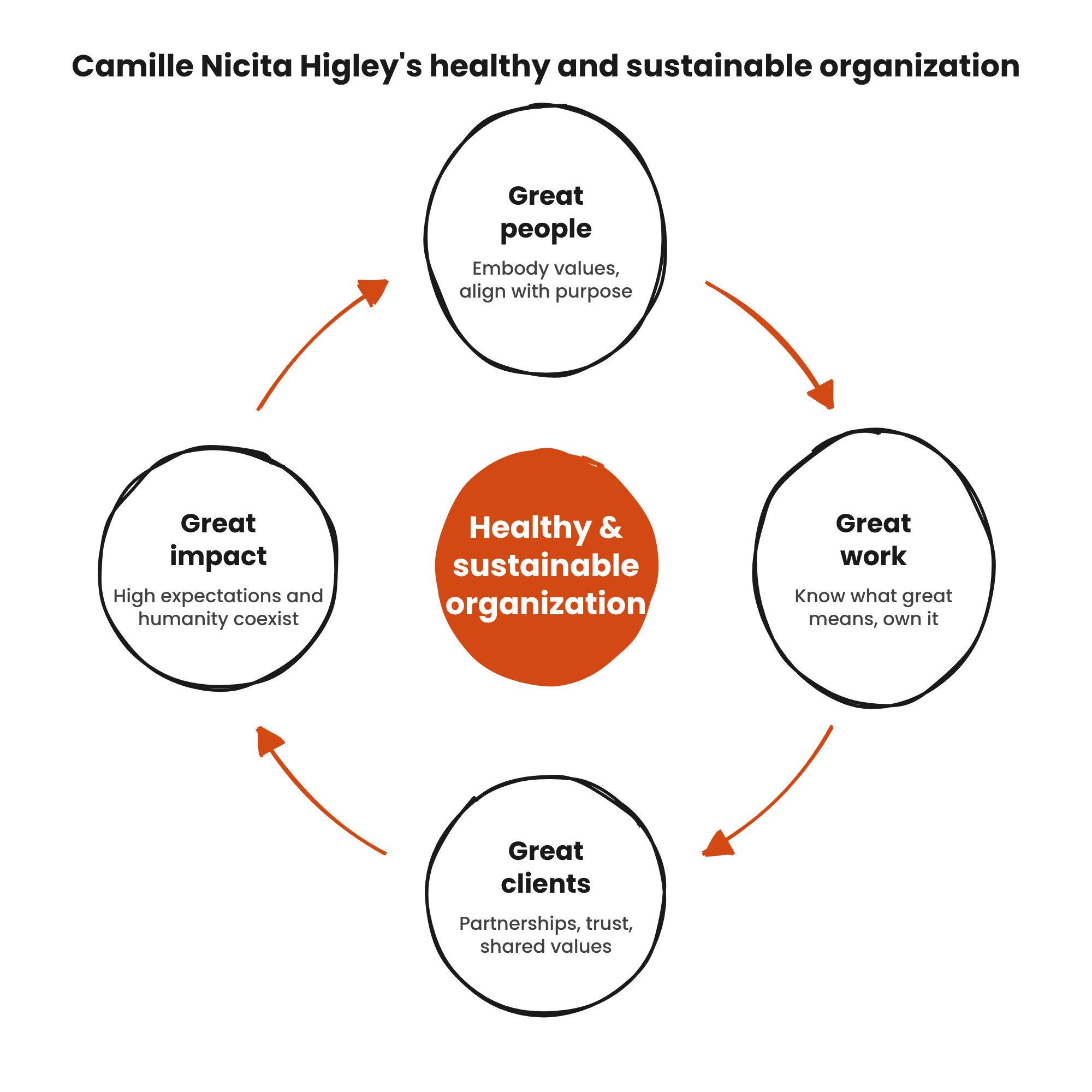
Adapted from Open When by Camille Nicita Higley
Camille's version starts with great people who embody your values and sign up to your purpose. Give them ownership and be clear what great work looks like. Great work attracts great clients, the kind where there's trust and shared values rather than just a contract. And great people doing great work for great clients creates great impact.
What I like most is the line she wrote underneath: high expectations and humanity can coexist. Not one or the other.
Someone in the community described Camille’s book, Open When, as the playbook for Small Giants companies. Having read it, I wouldn’t argue.
Danny's virtuous cycle of Enlightened Hospitality
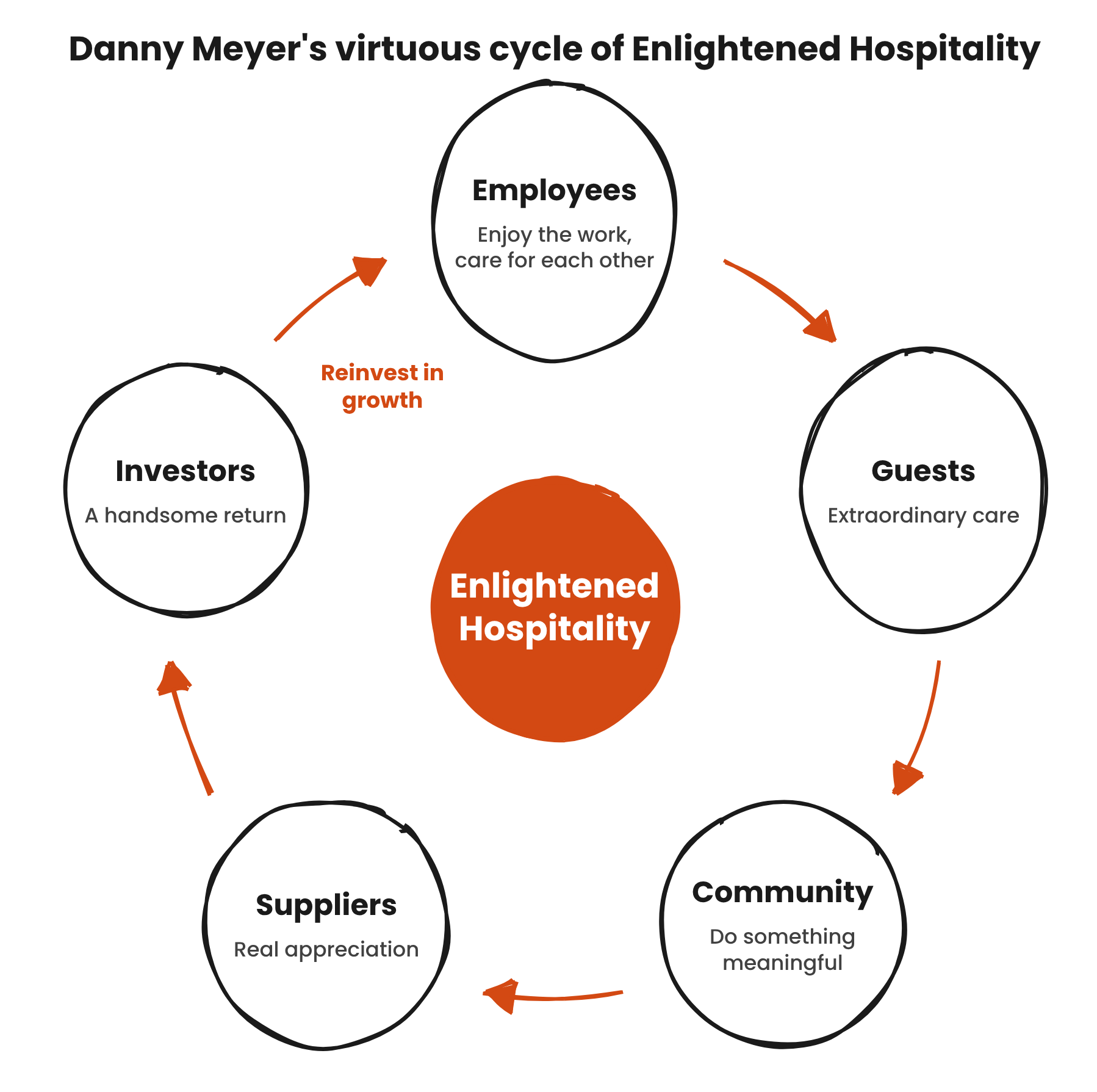
Adapted from Danny Meyer's book What Could Possibly Go Right?
Danny's wheel is the one I've been living with most this month. I loved reading his new book, What Could Possibly Go Right?, and found myself underlining passages page after page. He had me from the first chapter.
He calls the idea Enlightened Hospitality, and he's deliberate about the order. Employees first, because you can't ask people to take care of guests if they don't feel taken care of themselves. Then guests. Then the community the restaurant sits in, and suppliers who make it possible. Then, last, the investors. When investors see a handsome return, they're inclined to keep investing, and that growth is what creates the next restaurant, the next promotion, the next raise for the people who put the flywheel in motion.
That's the flywheel effect. This isn't a sequence, it's a system, where each element matters and reinforces the whole. Each turn pushes the next, and the last one pushes the first, so the more it spins the easier it spins.
Danny puts investors last on purpose. Not because they don't matter, it's because he spent years wrestling with how to keep the mojo alive in his business while also looking after his investors. As I read it, the wheel is the answer. If you get the first turn right, the last turn takes care of itself. Try it the other way around and you lose both.
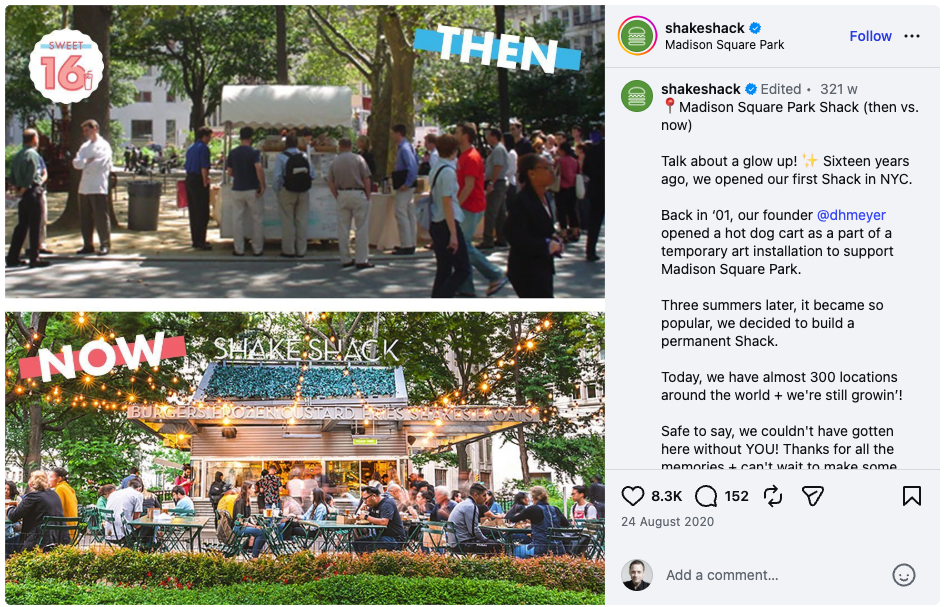
Shake Shack: Now & Then
Then there's the hot dog cart. Shake Shack started as a cart in Madison Square Park, put there to help bring the park back to life. It grew into something enormous, and the success became its own trap. When his team tried to repeat it with a pizza concept, built from a proper business plan, it didn't work. His diagnosis is one sentence:
"Shake Shack hadn't been conceived with any intention to scale. It was born with purpose, to prove Enlightened Hospitality could work for a hot dog cart in a park."
Which is why one of his other lines stayed with me too: the bigger we get, the smaller we need to act.
Union Square Hospitality Group was one of the original Small Giants, so maybe it's no surprise this reads like our playbook.
What the three have in common
Three turns, four turns, five turns. Lay them side by side and three things jump out.
They all start with people. Not with strategy, not with the product, not with the market. With how the people doing the work feel about doing it.
They all need a purpose in the middle. Paul's circle, Camille's hub, Danny's hot dog cart in a park. Without a reason the wheel exists, there's nothing to filter the decisions through, and the wheel spins toward whatever's loudest that quarter.
And none of them turn without trust. It isn't drawn on any of the three, but it's what holds every turn to the next one. People trusting the leader, clients trusting the company, the leader trusting people enough to hand over real ownership.
Paul tells the story of a competitor backed by venture capital whose circle was spinning backwards: forbidden by the number crunchers from investing in his people, he ended up with a workforce that couldn't hold on to customers, got pushed into competing on price, and eventually sold a business he never wanted to sell.
When trust goes, the wheel doesn't slow down. It stops.
One wheel for Small Giants
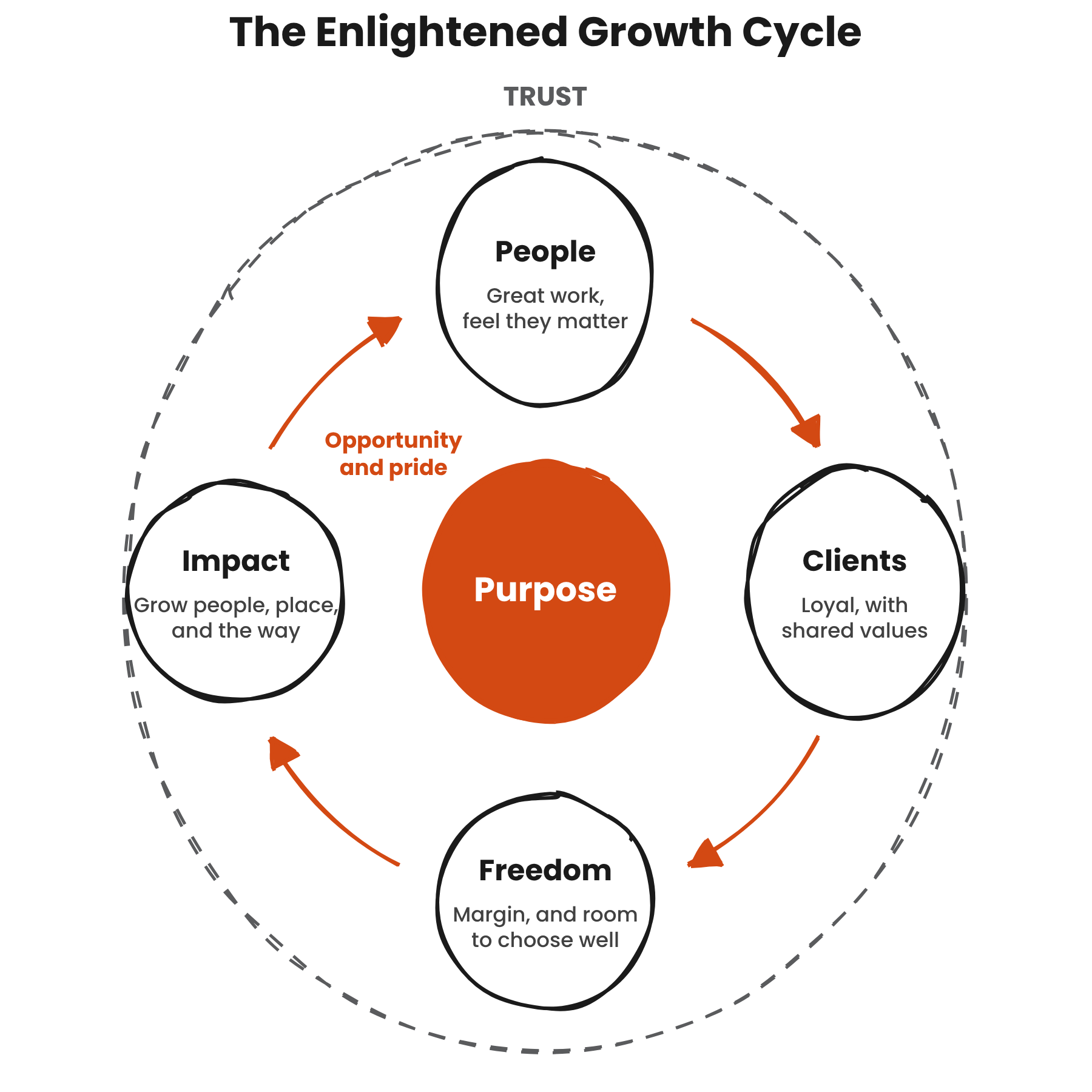
So here's my attempt at putting the three together in Small Giants language.
Purpose in the middle, the company's own, whatever it is. People who do great work and feel they matter. Clients who stay because of shared values. The freedom that margin gives you, and the room to choose well with it. And the impact you create with that freedom: growing your people, your place, and lighting the way for other businesses. Impact flows back to people as opportunity and pride, and the faster it turns, the easier it turns. Trust is the ring around all of it.
The one turn that isn't on the other three is freedom. I put it there on purpose. Every company we've visited on the road trip has a story about an offer, a contract or a growth path they turned down, and that choice is where great, not big actually gets decided.
Paul tells the story of BerylHealth passing up a deal that would have doubled its size, and walking away from half a dozen acquisitions that looked perfect on paper. They kept finding themselves, in his words, instinctively turning down growth for growth's sake.
I'd love to know what you think. Does it match how your business turns? What's missing? Reply and tell me, I read every one.
One thing to take away
All three wheels start at the same place, which means they all get stuck at the same place. If your people don't feel they matter, nothing downstream fixes it. Not pricing, not marketing, not reinvestment.
It came up again on a call we hosted this week with the team from Common Trust, who help owners move their companies into employee ownership. Zoe put it simply: before any transition, you need line of sight to your next generation of leadership. Not people already in the seat, but a real plan for who leads next. And Joe, one of our members, added the bit most owners learn the hard way. Ownership can be transferred in all sorts of ways. Leadership and governance are the hard part.
That's why the Leadership Academy exists. It's where Small Giants companies develop the people who'll keep the wheel turning when the founder steps back. The next cohort kicks off in January and applications are open now. If there's someone in your business you can already picture leading it, this is the moment.
Cheers,
Jean
Submit Your Comment