

Traditional, profitable, sustainable, long-term businesses — variously referred to as “lifestyle” or “non venture-backable” businesses by VCs — and their founders find themselves with few options for capital and little respect for their efforts and the companies they create. There’s nothing inherently wrong with venture capital. I just think we need to make room for what I refer to as “Real businesses”.
Real businesses aren’t necessarily small businesses. The company I founded currently has four offices and more than 100 employees. We’re in the 90th percentile of revenue for our industry. I know many leaders of Real businesses that have hundreds or even thousands of employees with revenue in the hundreds of millions. Most of them started small, kept their ownership internal, and grew steadily and organically over many years. Instead of exclusively pursuing growth, they pursue sustainable growth and profitability.
I’m not anti-VC. The venture capital industry in the US is of vital importance and the envy of the world. Some of my best friends are VCs. Being a venture capitalist was part of my working career. I’ve personally invested significantly in very early stage companies and done pretty well with a diversified portfolio and patience. I try to be clear when I’m advocating for more capital and support for Real businesses that I’m not against venture capital, I just think our communities would be better places if we create new sources of capital and a new narrative for founders and companies who neither fit into, nor aspire to, the VC model.
The best Real businesses find their tribe in organizations like the Small Giants Community and Tugboat Institute. There’s a healthy overlap between Tugboat’s seven Evergreen principles and the major elements of the Small Giants model of business. Both of these models also run contrary to what many people think of when they think of how companies are organized, funded, and operate. From an economic and community development perspective, the tradeoffs between VC-backed startups and Real businesses lie in risk, return, and impact.
In the table below I’ve tried to capture the differences between VC-backed and Real businesses. While the differences are holistically significant, my analysis is necessarily based on generalizations. It’s not hard to quibble or find exceptions with many of these considerations.
|
Considerations |
VC backed companies |
Real businesses |
|
Types of business |
Scaleable, high-growth only |
Any |
|
Top priority |
Growth, raising money |
Profitability |
|
Ownership |
Majority VCs and individual investors |
Founders and sometimes employees |
|
Odds of success |
Low |
Higher |
|
Robustness |
Fragile |
Robust |
|
Longevity under founder |
Most likely < 10 years |
Bounded by mortality |
|
Job creation potential |
Large, highly variable |
Smaller, more steady |
|
Potential for innovation |
High |
Low |
|
Strategy |
Product innovation and/or business model |
Culture |
|
Return to investors |
Upon exit (sale or failure) |
Usually through profits |
|
Return variance |
High |
Lower |
|
Community engagement |
Subordinated to growth; typically low |
Depends on founder’s values |
My interest is not in destroying or even diminishing the VC model. Rather, it’s to raise the status of and support for Real businesses.
Supporting Real Businesses: An Experiment
I ran an experiment this year and brought five founders of young, Real businesses to the Small Giants Summit. The five companies were on the smaller side of the size range of participating companies, consistent with their age. They included a group therapy practice, a horizontal drilling company, and three nascent consulting firms with specific, targeted audiences. My hope was that introducing them to the Small Giants Community (SGC) early in their lifecycles, before they can afford the registration fee, will pay dividends for them and my community over the long haul.
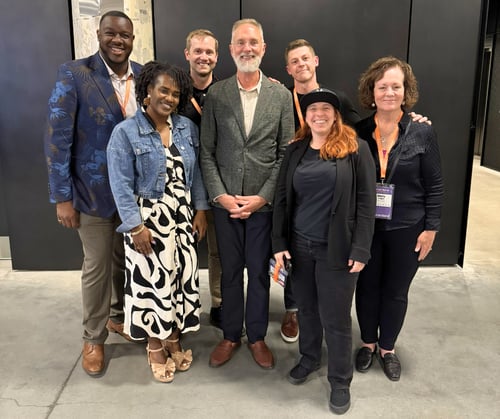
I’m very happy to say the experiment was a success!
Here are some examples of the impact the Summit had on my founder mentees:
- They met and got to know each other. Four of the five live in the same city, but hadn’t met before. This suggests to me a need for community that is not being met by the many excellent entrepreneurial support organizations we have.
- Two different pairs talked in detail about doing business with each other. One of the pairs is doing just that today.
- One founder volunteered for a “fish bowl” experience where a room of 75 company leaders listened to a challenge she was facing and offered their suggestions and relevant experience.
- All of them met business leaders from like-minded companies — they found their tribe.
- Another founder made such a good connection with a distinguished member of the SGC that he visited his company in Chicago to see their values in operation.
- One founder crafted, tested, and refined her tag line around a table with seven other experienced founders offering feedback.
- All five heard personal stories and expert talks about legacy, team building, failures, perseverance, employee recognition, team productivity, etc.
- All five came away from the Summit feeling excited, encouraged, affirmed, and with new connections to like-minded companies.
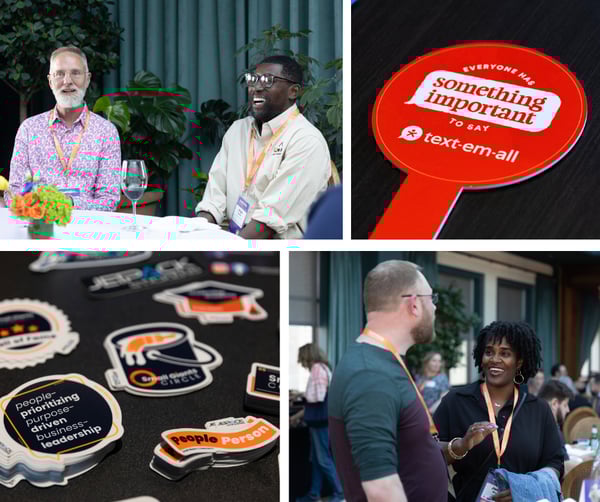
The Summit is thoughtfully curated both on an individual experience basis (e.g. you’re assigned specific tables for some events) as well as a theme, speaker, and topic basis. The culture of SGC is friendly, supportive, honest, sharing and vulnerable, which in my experience accelerates and amplifies learning.
While I covered registration costs, each founder paid their own travel and lodging expenses. More dearly, they dedicated two days of precious time that could have gone into their business. I look at what I spent on registrations as an investment and a personal form of economic development.
I strongly believe that helping to create successful Small Giant companies will make the city I live in more prosperous and equitable.
My experiment is an easy one to replicate. Economic development organizations, chambers of commerce, entrepreneurial support organizations, CDFIs, and city governments could all host their own cohort at a Small Giants Summit. The SGC staff happily created a custom discount code for me and sent me a single invoice. The founders I introduced to SGC were people I had an ongoing mentorship relationship with, but it’s easy to imagine other ways of identifying participants. Companies that could benefit range from small and young, to larger and more mature.
I’m tending seedlings, but the impact on leaders of larger companies that align with the Small Giants model of business can also raise their game and benefit their employees and communities by experiencing the Small Giants Community.
The Small Giants Community blog and resource library are made possible by our Community members and the financial support of:

Submit Your Comment