
Make sure to check out the previous blogs in this series: our introductory blog, and the case studies on WEBIT Services and Wasserle GmbH.
Previously in our Business Operating Systems (BOS) blog series, we’ve surveyed the different kinds of systems available, and explored the implementation journey of two Small Giants companies. Now, we’re turning to our third case study, OpenTent, a Salesforce consulting business that works exclusively with non-profit organizations.
Sam Adiv, founder and CEO, started the company a decade ago, and as the employee count grew (at one point there was a growth of 10 new hires in 9 months), he and his leadership team knew they needed structure to propel them forward. Sam, along with COO Sara Habib, wanted a solution that would align their team operationally, so they could focus on the work itself.
To navigate the company’s growth, the leadership team looked to operating systems. After some trial and error, as well as the team’s experiences with previous employers, they settled on a powerful trio of systems: Entrepreneurial Operating System (EOS), Open Book Management (OBM), and Scrum.
➡️ HOW EFFECTIVELY DOES YOUR TEAM OPERATE? FIND OUT BY TAKING THE ARE YOU A SMALL GIANT? SCORECARD.
The turning point came in 2019 and 2020, when the company adopted EOS followed closely by Open Book Management. These were critical steps for creating shared clarity and trust during a season of accelerated hiring. The final piece, Scrum, arrived in 2021 to unify how work was delivered across engineering, project management, product, and admin roles.
One of the key benefits of using these operating systems has been a defined team structure to better support the company’s culture, values, and performance. They utilize the Visionary/ Integrator model from EOS, and also have a group within the leadership team called the “A-Team” (for accountability). In regards to the wider employee population, they serve clients via two “Portfolio Teams” made up of engineers, project managers, product owners, and Salesforce admins. Having these frameworks allows for stronger team collaboration, motivation, and clarity on responsibilities.
OpenTent uses structure, transparency, and rhythm to navigate rapid growth – expanding from 3 to more than 20 employees in just a few years – and in the process has built a culture where people feel empowered, informed, and connected.
Read our interview with Sara Habib to get a closer look at OpenTent’s journey, and lessons learned along the way.
 Interview with Sara Habib
When did your company decide to introduce these operating systems? Describe what it was like before and why the change happened.
We started to use EOS in 2019. We introduced Open Book Management in 2020.
The company needed more structure as we grew from 3 people to 8 people to 13 people to 20 people. We hired 10 people in 9 months. Our high-level leadership needed support to navigate these transitions and to provide structure for the rapidly expanding team.
As we adopted these frameworks, we started to get more into the rhythm of working together and to focus on DOING the work instead of HOW the work would happen. It's incredibly important to create containers, space, and alignment for people to focus on what is most important. The rituals of EOS are what provide stability and infrastructure for growth.
Open Book Management is critical because if you want everyone to make decisions and act like an owner, you should treat them like an owner. Providing visibility into the good and the bad the company is experiencing is an incredible tool to build trust.
We started doing Scrum in earnest in 2021. We moved our work into Portfolio Teams in order to provide supportive structures for client delivery. Doing the work to standardize our process across teams took a while, but it was incredibly worth it. Now the company runs on the same Scrum schedule across all projects, and everyone is aligned on (most of!) the processes we use to deliver our work.
Who were the key stakeholders in this decision making process?
Founder Sam and Co-owner Kayleigh were the original stakeholders, and as our systems got more robust and we added more layers (and as I joined the company), we involved our Accountability Team as well.
Additionally, as with any change, every employee is a stakeholder! Change management and system adoption involves buy-in at every level of the business to be effective.
When you think about the announcement of implementing a new operating system, and the process of getting it fully implemented, how did your team react? How did you ensure that everyone remained informed during this process?
I think change management is more than 50% of the success of any new initiative, maybe even more like 90%. You need to really break things down so that everyone understands exactly what is changing and why.
The format I like to use is:
- Here is our current state. Here is the "problem". (Background/history)
- Here is what we have explored in solving the problem and how the company is thinking about it right now.
- Here is the solution we landed on. This is our best guess right now as to how to resolve it.
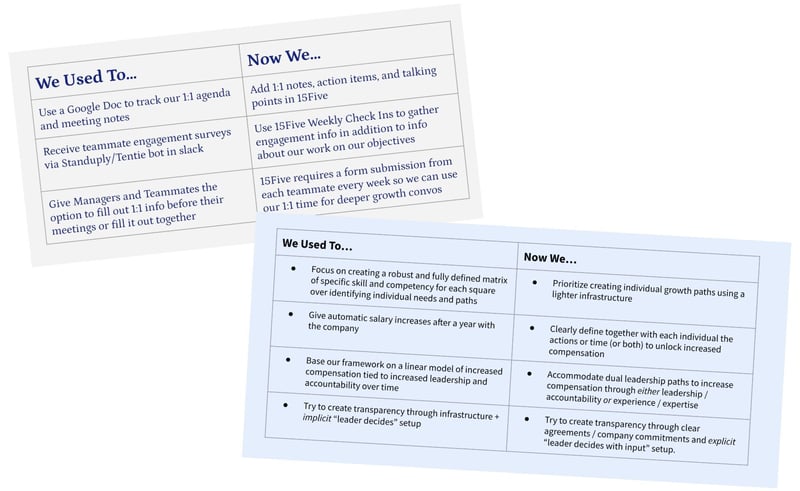
- "We Used To... / Now We..." table. In one column, list the way we used to do things. In the next column, list what we do now. This really helps people understand in practical terms what is actually changing.
When we went through the change process at OpenTent, there was definitely a feeling of relief. Having structures and 'containers' in which work can happen is actually freeing. It released the team from the responsibility of deciding how to do the work and allowed them to just focus on getting the work done.
What happened as a result of the implementation of this system?
- We got much closer to “the right people in the right seats” across the company. Some people did leave the company as a result, but we see this as a good thing. This system helped people differentiate between what the company needed and what they personally needed. We created space for honest communication and simple ways for people to transition gracefully.
- So many people have stayed! Having the right system can make a huge difference in job satisfaction and work-life balance. Providing the framework and the container for the work to happen is a huge relief. Setting clear goals and having regular meeting rhythms and rituals allows for space to bring up issues easily -- you know the meeting will happen and there will be time to talk it through, so you don't worry about when or how to address it.
- One other thing we did simultaneously is really focused on building a culture of direct and honest feedback. We created feedback loops that range from formal to very informal. We encourage a "name it to tame it" mindset and relationship-building that encourages repair instead of all-or-nothing perfectionism (which causes walking on eggshells). We leaned into the Enneagram as our assessment of choice and started to get to know each other more deeply. We invested in understanding and learning about what matters to us as individuals and collectively, which has unified our culture.
How did this help you align to Small Giants philosophies (people, values, purpose, mission)?
We were already holistically aligned with the Small Giants philosophy, and these frameworks helped us evangelize and promote these philosophies internally. It gave us a clean and organized way to share what matters to the company, our vision for the future, and to share "people like us do things like this."
It made it easy to communicate and get buy-in on the philosophical pieces because we now HAD TIME instead of trying to reinvent the wheel every project or every quarter.
How does this system help you preserve your culture?
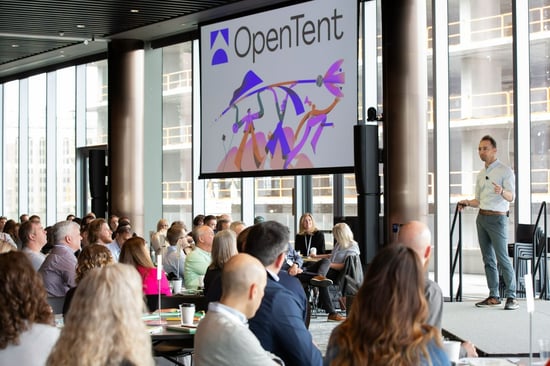
Our mission as an organization is to "Make Work Suck Less." Our culture is built around this mission and around our core values. EOS gives us concrete tools to keep our values and mission front and center. We also believe deeply in enabling a sense of play at work. Because we are a remote-first company, it means our slackmoji and gif game is extra strong!
What challenges or tradeoffs did you encounter as a result of using this system?
One challenge we experienced was finding the right functional accountability leaders. We used a concept from Scaling Up, PACe and FACe charts, to identify who should hold accountability for different functions of the business.
We didn’t have the right people in those seats or the right level of leadership experience on the team. This meant we had a bit of a learning curve for leadership accountability. Moving from informal leadership to clearly defined roles and measurables took a lot of talking and alignment-building and learning on the job!
How have you measured the success of the implementation of this system?
We survey our teammates quarterly. We look at how many folks would recommend others to work here, how much visibility people feel into leadership decisions, what level of trust the team has that their perspectives are being considered by leadership, etc. Since we are a pretty small team, it's easy to see if numbers shift and be able to understand why.
What was the most challenging or surprising part of getting your operating system up and running?
One thing that has consistently been challenging for us is a meaningful scorecard. We have struggled to find metrics which track the things that really matter to the company on a weekly basis. This is in part because our business is a long-term value-based subscription – we don’t use billable hours and our team has limited ways to affect our economic model besides client satisfaction (which is always high!).
How has this system impacted the way you scale or approach growth?
The Annual Meeting has really helped us approach strategic planning beyond the short term. Considering 3 years in the future has helped us understand what is important to focus on.
Our Portfolio Team structure has helped us scale. It forced us to align across teams about our process, but it also gave us smaller groups in the company where processes could be tested and developed. We give the teams a considerable level of autonomy to try new things – it allows for flexibility and adaptability to find new ways to make work more joyful or efficient.
How do you see this system impacting how your team views your company's future?
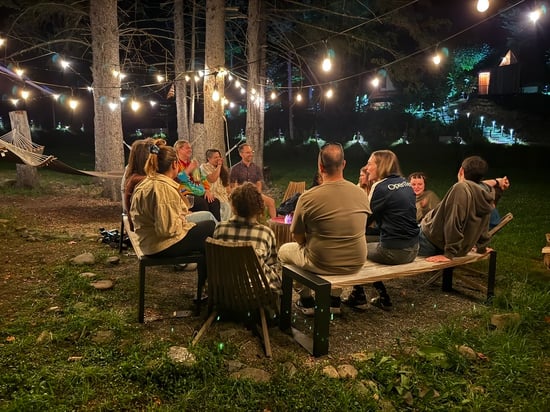
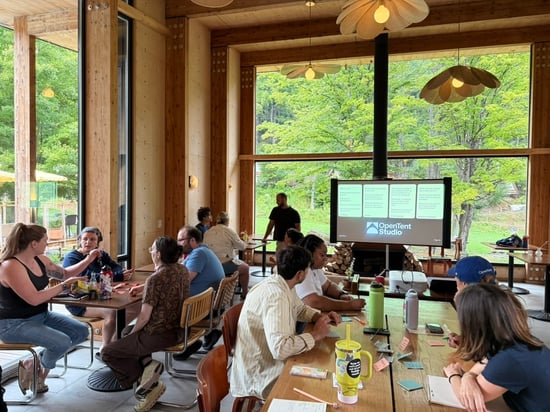
We share back with the team every quarter during our all-hands Company Campfires. We share about profitability, about changes and rocks that are coming up, and revisit last quarter's rocks.
Having the quarterly ritual to support sharing back helps everyone feel grounded in our work. The team knows they will have an opportunity to connect and reflect and plan together every quarter, and a chance to ask questions about vision and strategy. We have created a ton of buy-in via this regular check in with everyone.
Some operating systems come with very specific, rigid parameters. Have you tweaked your initial setup at all to better suit your team and your organization?
Heck. Yeah.
We definitely treat these tools like starting points rather than finish lines. It has always been my process to adapt tools to fit organizational needs as much as possible. If you choose the right framework there shouldn't need to be too much adjustment.
And, we have seen that sometimes we actually do need to circle back and do it "Gino's Way" when using EOS frameworks. We recently tightened up our L-10 process and that shift has really improved the quality of our leadership team meetings.
Do you see your operating system as an evergreen structure that will help you build a sustainable future for your company, or a temporary bridge to help you advance to the next level?
Both! I think every company should have an operating system of some kind. It doesn't have to be EOS, but I think it is a critical part of sustainability and growth. It is foundational and crucial.
For us, EOS could be a temporary bridge. We do take time to consider what system we are using and whether we should shift to something else as part of our strategic process. This feels important to keep reviewing and revising as thinking around business evolves.
I've learned a ton from Aaron Dignan's book Brave New Work that I continue to incorporate, and I'm always looking for different methods and tools to help us improve and grow.
Share a few tips or best practices that you would recommend to other companies setting up this system.
- There is value in using external coaches/ implementers as well as developing system rituals without one. When there is disagreement about how to follow the systems, it is very helpful to have an EOS implementer or a Scrum coach to help guide the team as an external authority. It is also incredibly worthwhile to have teams make these rituals and systems their own. If people feel like they have flexibility to make the system work for them, it's considerably easier to get folks to adopt it.
- Be prepared to iterate over and over again. The work of systems development is pretty much never done. Especially as work changes and evolves (and the world evolves around us; it feels like everything is moving faster and faster!), we need to be able to adapt to shifting needs of clients, the company, and our greater community.
- I highly recommend doing some psychological safety assessments before implementing a massive system change. If there is a low level of psychological safety on the team, you will absolutely need to address that first.
The Small Giants Community blog and resource library are made possible by our Community members and the financial support of:


Submit Your Comment